
Dell PowerEdge M830 SSD Upgrade
Upgrade your enterprise storage infrastructure with high-capacity enterprise solid state drives from Cloud Ninjas, designed to deliver the highest performance, scalability, and efficiency for servers, workstations and all HPC systems.
Browse our selection of SATA, SAS, and all variants of NVMe in multiple capacities and conditions keep your business running at peak performance!
- Supported drives: SATA, SAS
- Max Configuration: 12 x 1.8" drives
- Max capacity: 92.16TB
CONTACT FOR INQUIRES:
sales@cloudninjas.com

 Filters
Solid State Drives
30 Items-
Premium Storage
 Key Specs
- 7.68TB
- SAS
- New Drive
- 24GB/s Transfer Speeds
- 11th/12th/13th Gen Dell Servers
- 2.5-inch Drive
- Optional 2.5/3.5-inch Drive Tray
- 1 DWPD
$6,499.00In Stock -
HPC Optimized
 Key Specs
- 3.84TB
- SAS
- New Drive
- 24GB/s Transfer Speeds
- 1th/12th/13th Gen Dell Servers
- 2.5-inch Drive
- Optional 2.5/3.5-inch Drive Tray
- 1 DWPD
$4,495.00In Stock -
RAID Optimized
 Key Specs
- 1.92TB
- SAS
- New Drive
- 24GB/s Transfer Speeds
- 11th/12th/13th Gen Dell Servers
- 2.5-inch Drive
- Optional 2.5/3.5-inch Drive Tray
- 1 DWPD
$2,900.00In Stock


Dell PowerEdge M830 Solid State Drive Upgrades
The Dell PowerEdge M830 is a blade server with configuration of 4x 2.5" SATA/SAS or 12x 1.8" SAS SSDs. This Dell PowerEdge M830 supports the following types of solid state drives: SATA, and SAS. The capacities supported by this server range from 120GB to 7.68TB and offers speeds of 3GB/s, 6GB/s, 12GB/s and 24GB/s depending on the type of solid state drive. The max capacity configuration available for this server is 12x 7.68TB SAS. It is not advisable to mix the types of drives as the server will run inconsistent due to SSD drive speeds. If you want to maximize the capabilities of the Dell PowerEdge M830, choose one type of Solid State Drives to maintain consistency when running your server nodes.
Technical Guide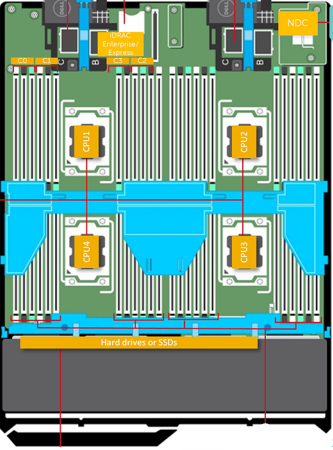
Cloud Ninjas Dell PowerEdge M830 Solid State Drive Upgrade Tips
-
 There are 2 different types of SSD interfaces: SATA, and SAS.
-
 There are multiple SSD capacities: 120GB, 240GB, 480GB, 800Gb, 960GB, 1.6TB, 1.92TB, 3.2TB, 3.84TB, 7.68TB.
-
 Maximum total capacities for SATA drives is 7.68TB, and 7.68TB for SAS of storage memory.
-
 Speed of drives for the Dell PowerEdge M830 server range from: 3GB/s to 24GB/s for SATA, SAS and NVMe. But they may clockdown depending on the type of SSD.
-
SAS Support from optional SAS HBA/RAID card.
-
There are 2 type of Dell PowerEdge M830 chassis from a storage perspective: 4x 2.5" SATA/SAS and 12x 1.8" SAS drives.
-
You can mix SSD types; however, it is advised that consumer chooses one type of SSD for the entirity of the servers SSD capabilities, in order to maintain consistency.