
Dell PowerEdge R430 Server
At Cloud Ninjas we offer the opportunity of you configuring the Dell PowerEdge R430, with a catalog of different possible chassis and the best prices so you can upgrade your business at the best price for performance. With dual Intel Xeon E5-2600v3 & E5-2600v4 CPUs and 12 memory modules possible, the R430 is an older server that 10 years later can still run enterprise software, delivering reliable performance, energy efficiency, and a flexible configuration for workloads such as, homelabs, virtualization, file and printing services, and database workloads.
- 1U Rackmount
- Virtualization
- Intel Xeon E5-2600 v3 & v4
- Entry Database Tasks

Configure your Dell PowerEdge R430 Server
Dell PowerEdge R430 Server Specifications
Cloud Ninjas' Dell PowerEdge R430 Specifications
Chassis
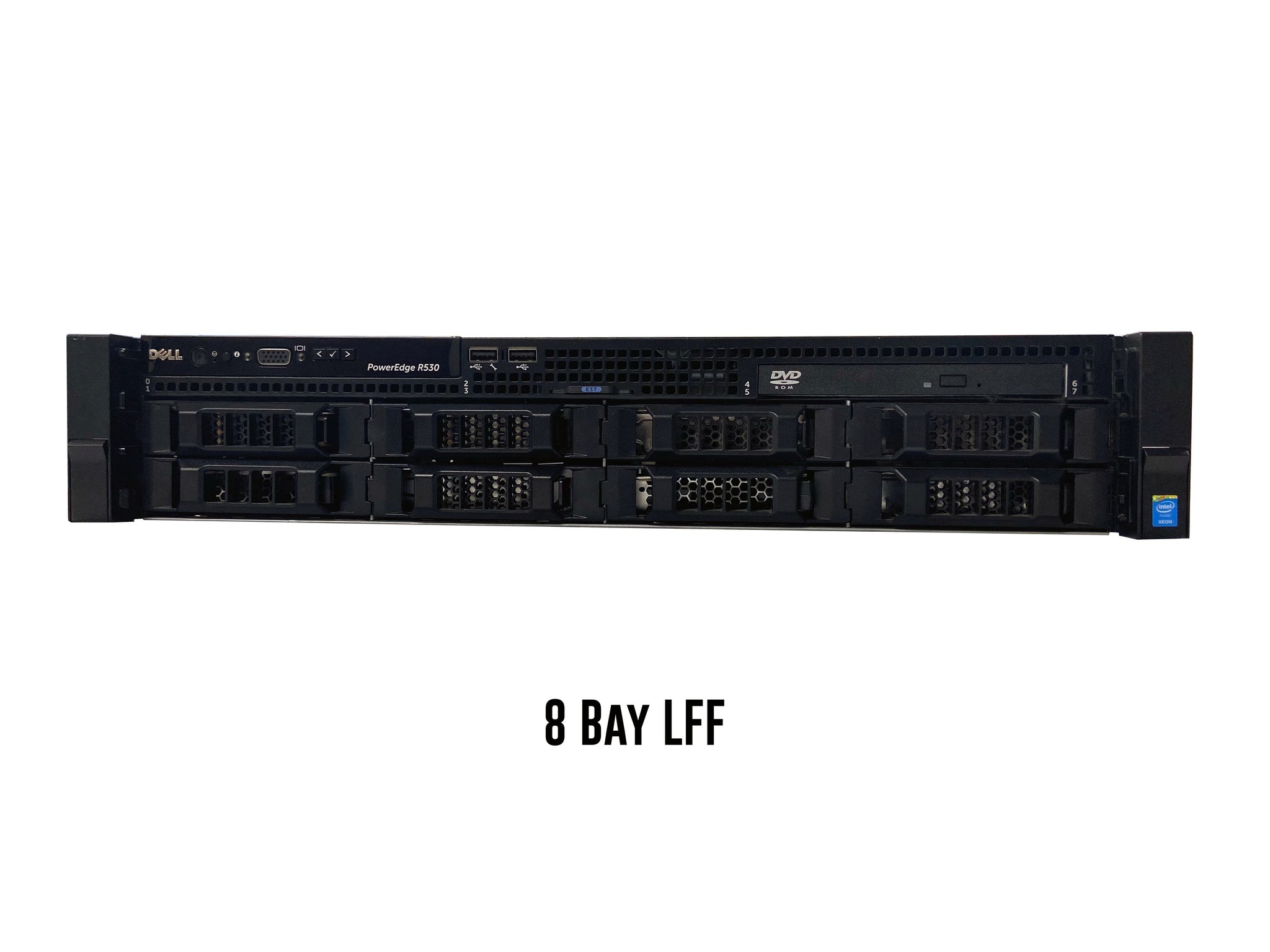
The Dell PowerEdge R430 Rackmount server has two different chassis options that you can choose from. The chassis options are mainly defined by the number of drive bays there are. Each R430 chassis supports hot-swap drives, meaning that drives can be added or removed while the system is powered on. The chassis options are 4 Bay LFF and 8 Bay LFF.
4 Bay LFF
The 4 Bay LFF R430 chassis can hold up to four 3.5” hard drives and/or SSDs. There is support for both SAS and SATA drives.
8 Bay SFF
The 8 Bay SFF R430 chassis can hold up to eight 2.5” hard drives and/or SSDs. There is support for both SAS and SATA drives.
Risers and PCIe Slots
The risers and PCIe slots are the same across the 4 Bay LFF and 8 Bay SFF chassis. There is a total of 5 PCIe 3.0 slots. There is one optional riser that takes up two PCIe slots and on the riser there are two PCIe slots. These two slots accept low profile cards only.
Processing Power
The Dell PowerEdge R430 Server has two LGA2011-3 CPU sockets which accept Intel Xeon E5-2600v3 and E5-2600v4 series processors. These processors have fantastic support for virtualization. A maximum of 22 cores can be used per processor. It is important to note that to use v4 processors, you may need to update your BIOS.
Intel Xeon E5-2600 v3 Series Processors
| CPU | Step Code | Cores | Frequency |
|---|---|---|---|
| E5-2603v3 | SR20A | 6 | 1.60 GHz |
| E5-2608Lv3 | SR21P | 6 | 2.00 GHz |
| E5-2609v3 | SR1YC | 6 | 1.90 GHz |
| E5-2618Lv3 | SR200 | 8 | 2.30 GHz |
| E5-2620v3 | SR207 | 6 | 2.40 GHz |
| E5-2623v3 | SR208 | 4 | 3.00 GHz |
| E5-2628Lv3 | SR1XZ | 10 | 2.00 GHz |
| E5-2630v3 | SR206 | 8 | 2.40 GHz |
| E5-2630Lv3 | SR209 | 8 | 1.80 GHz |
| E5-2637v3 | SR202 | 4 | 3.50 GHz |
| E5-2640v3 | SR205 | 8 | 2.60 GHz |
| E5-2643v3 | SR204 | 6 | 3.40 GHz |
| E5-2648Lv3 | SR1XW | 12 | 1.80 GHz |
| E5-2650v3 | SR1YA | 10 | 2.30 GHz |
| E5-2650Lv3 | SR1Y1 | 12 | 1.80 GHz |
| E5-2658v3 | SR1XV | 12 | 2.20 GHz |
| E5-2658Av3 | SR27T | 12 | 2.90 GHz |
| E5-2660v3 | SR1XR | 10 | 3.30 GHz |
| E5-2667v3 | SR203 | 8 | 3.20 GHz |
| E5-2670v3 | SR1XS | 12 | 2.30 GHz |
| E5-2680v3 | SR1XP | 12 | 2.50 GHz |
| E5-2683v3 | SR1XH | 14 | 2.00 GHz |
| E5-2690v3 | SR1XN | 12 | 2.60 GHz |
| E5-2695v3 | SR1XG | 14 | 2.30 GHz |
| E5-2697v3 | SR1XF | 14 | 2.60 GHz |
| E5-2698v3 | SR1XE | 16 | 2.30 GHz |
| E5-2699v3 | SR1XD | 18 | 2.30 GHz |
Intel Xeon E5-2600 v4 Series Processors
| CPU | Step Code | Cores | Frequency |
|---|---|---|---|
| E5-2603v4 | SR2P0 | 6 | 1.70 GHz |
| E5-2608Lv4 | SR2P9 | 8 | 1.60 GHz |
| E5-2609v4 | SR2P1 | 8 | 1.70 GHz |
| E5-2618Lv4 | SR2PE | 10 | 2.20 GHz |
| E5-2620v4 | SR2R6 | 8 | 2.10 GHz |
| E5-2623v4 | SR2PJ | 4 | 2.60 GHz |
| E5-2628Lv4 | SR2NC | 12 | 1.90 GHz |
| E5-2630Lv4 | SR2P2 | 10 | 1.80 GHz |
| E5-2630v4 | SR2R7 | 10 | 2.20 GHz |
| E5-2637v4 | SR2P3 | 4 | 3.50 GHz |
| E5-2640v4 | SR2NZ | 10 | 2.40 GHz |
| E5-2643v4 | SR2P4 | 6 | 3.40 GHz |
| E5-2648Lv4 | SR2ND | 14 | 1.80 GHz |
| E5-2650Lv4 | SR2N8 | 14 | 1.70 GHz |
| E5-2650v4 | SR2N3 | 12 | 2.20 GHz |
| E5-2658v4 | SR2NB | 14 | 2.30 GHz |
| E5-2660v4 | SR2N4 | 14 | 2.00 GHz |
| E5-2667v4 | SR2P5 | 8 | 3.20 GHz |
| E5-2680v4 | SR2N7 | 14 | 2.40 GHz |
| E5-2683v4 | SR2JT | 16 | 2.10 GHz |
| E5-2687Wv4 | SR2NA | 12 | 3.00 GHz |
| E5-2690v4 | SR2N2 | 14 | 2.60 GHz |
| E5-2695v4 | SR2J1 | 18 | 2.10 GHz |
| E5-2697Av4 | SR2K1 | 16 | 2.60 GHz |
| E5-2697v4 | SR2JV | 18 | 2.30 GHz |
| E5-2698v4 | SR2JW | 20 | 2.20 GHz |
| E5-2699v4 | SR2JS | 22 | 2.20 GHz |
| E5-2699Rv4 | SR31X | 22 | 2.20 GHz |
| E5-2699Av4 | SR30Y | 22 | 2.40 GHz |
Memory
DIMM Slots & Channels
The Dell PowerEdge R430 has a total of 12 DIMM slots on the motherboard. There is a total of 8 memory channels. The memory channels by CPU 1 has two DIMM slots per channel. By CPU two, the memory channels only have one DIMM slot per channel.
Memory Types & Module Capacities
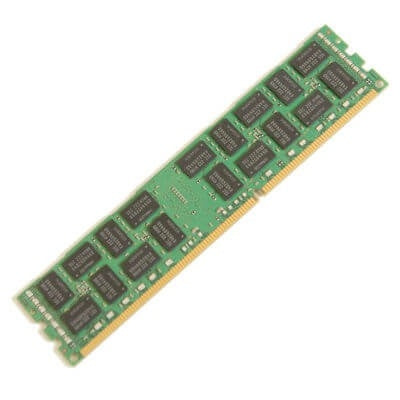
The R430 takes DDR4 ECC Registered memory (RDIMM) as well as DDR4 Load Reduced memory (LRDIMM). Supported DIMM capacities include 4GB, 8GB, 16GB, 32GB, and 64GB. One thing to take note of is that 64GB modules can only be used with one time of RAM: Load Reduced. With load reduced memory, you can achieve an overall higher memory capacity.
Max Configurations
With RDIMMs, a maximum capacity of 384GB can be reached with a configuration of twelve 32GB modules. On the other hand, for LRDIMMs, a max capacity of 768GB can be reached with a configuration of twelve 64GB modules.
Supported Memory Speeds
The PowerEdge R430 accepts memory speeds of 2133MT/s and 2400MT/s. Modules with speeds of 2666MT/s, 2933MT/s, or 3200MT/s can still be installed, but they will clock down to 2400MT/s when using a E5-2600 v4 processor. When using an E5-2600 v3 processor, the fastest memory speed supported is 2133MT/s.
Storage
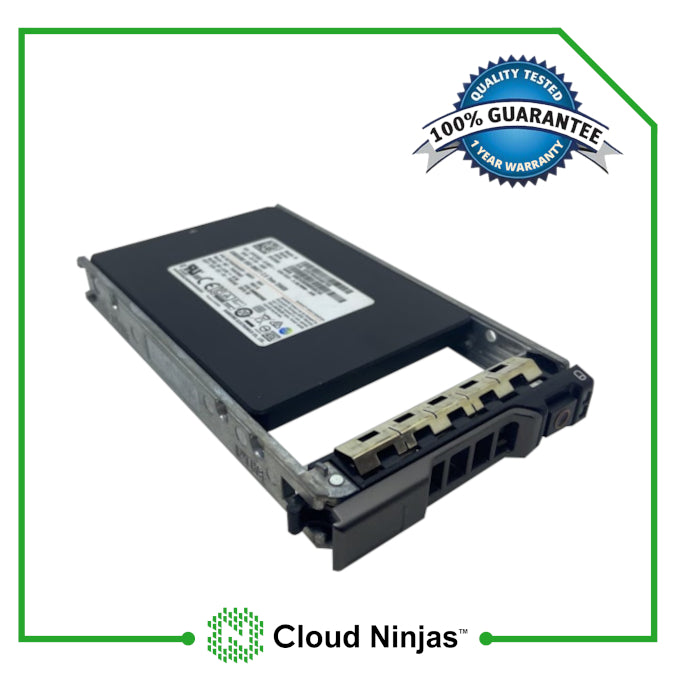
The Dell PowerEdge R430 server accepts different types of drives depending on the chassis option. The 4 Bay LFF chassis accepts 3.5” hard drives and/or solid state drives. The 8 SFF chassis accepts 2.5” hard drives and/or solid state drives. Both chassis support hot-swap drives, meaning that drives can be added or removed while the server is powered on.
Supported Drives
| Type | Max Capacity (Per Drive) 2.5" | Speeds |
|---|---|---|
| SAS | 2.4 TB | 10k or 15k |
| SATA | 2 TB | 7.2k |
| SSD | 7.68 TB | 3 GB/s, 6 GB/s, 12 GB/s |
| Type | Max Capacity (Per Drive) 3.5" | Speeds |
|---|---|---|
| SAS | 12 TB | 10k or 15k |
| SATA | 12 TB | 7.2k |
| SSD | 7.68 TB | 3 GB/s, 6 GB/s, 12 GB/s |
NVMe Options & Upgrades
NVMe is an amazing storage technology that has a ton of benefits. It is blazing fast which is desirable in certain enterprise environments. NVMe drives are much faster compared to traditional drives. Unfortunately there isn’t much NVMe support for the PowerEdge R430 server. There is only one option which is: PCIe NVMe. Neither U.2 or M.2 will work with this server.
PCIe NVMe
The only NVMe solution for the PowerEdge R430 is to use a PCIe NVMe drive. Even though this will work, there are quite a few limitations. First of all, cannot use any PCIe NVMe drive of your choice. You can only use drives that have Dell firmware. A non-Dell, OEM drive will not work. Even with a PCIe NVMe drive with Dell firmware, you are still restricted. You cannot use the drive to install an operating system or to create a virtual machine. The only thing that this NVMe solution can be used for is additional storage. One thing to check is to make sure that the slot disablement setting in the BIOS is enabled. If it is disabled, the drive will not be recognized by the server.
Power Supplies
How Many Power Supplies does the R430 Take?
The PowerEdge R430 server accepts a maximum of two hot-swap power supplies. Because the power supplies are hot-swap, you can remove the PSUs while the system is powered on. This will only work if one power supplies remains in the server.
Wattage Options
There are two power supply wattage options for the PowerEdge R430: 450W and 550W. The wattage you choose heavily depends on your application. If you server runs resource intensive programs, then a high wattage will be required. Also, higher end components will require more power, meaning it’ll be best to go with a higher wattage as well. For both scenarios, 550W is your best bet!
Voltage
One thing that can be easily forgotten about is the voltage. If you do not have a corresponding voltage for your connection type, then you will run into issues. There are two voltage options: 110v and 220v. If you use a 220v power supply with a 110v connection, the server will not power on.
RAID Options
| RAID Options | RAID Levels | Cache | Drive Speeds | PCIe Generation | RAID Hardware |
|---|---|---|---|---|---|
| S130 Onboard Software | 0,1,5,10 | None | 6 Gb/s SATA 12 Gb/s SAS |
PCIe 3.0 | Software |
| HBA330 Passthrough | Passthrough | None | 6 Gb/s SATA 12 Gb/s SAS |
PCIe 3.0 | Hardware |
| H330 Mini Mono | 0,1,5,10,50 | None | 6 Gb/s SATA 12 Gb/s SAS |
PCIe 3.0 | Hardware |
| H730 Mini Mono | 0,1,5,6,10,50,60 | 1GB | 6 Gb/s SATA 12 Gb/s SAS |
PCIe 3.0 | Hardware |
| H730p Mini Mono | 0,1,5,6,10,50,60 | 2GB | 6 Gb/s SATA 12 Gb/s SAS |
PCIe 3.0 | Hardware |
| H830 PCIe Adapter | 0,1,5,6,10,50,60 | 2GB | 6 Gb/s SATA 12 Gb/s SAS |
PCIe 3.0 | Hardware |
Network Interface Card Options
The Dell PowerEdge R430 has a 4 x 1GbE RJ45 network ports that are integrated into the motherboard. There is not slot for a daughter card on the back of the motherboard. This means that the only way for you to upgrade you R430’s networking capabilities is by installing a PCIe network card. There are both ethernet and fiber options. Since the integrated ports have 1 gigabit speeds, it is best to get a card with 10 gigabit speeds if upgrading your network cards.
| Network Card Options |
| Dell Broadcom 5719 Quad-Port 4 x 1GbE RJ45 NIC |
| Dell Broadcom 5720 Dual-Port 4 x 1GbE RJ45 NIC |
| Dell Broadcom 57810S Dual Port 2 x 10Gb DA/SFP+ Network Adapter |
| Dell Broadcom 57810S Dual Port 2 x 10GbE RJ45 Network Adapter |
| Dell Intel I350-T2 Dual Port 2 x 1GbE RJ45 Network Adapter |
| Dell Intel I350-T4 Quad Port 4 x 1GbE RJ45 Network Adapter |
| Dell Intel X520-DA2 Dual Port 2 x 10Gb DA/SFP+ Low Profile Network Adapter |
| Dell Intel X540-T2 Dual Port 2 x 10GbE RJ45 Network Adapter |
Systems Management Solutions
The Dell PowerEdge R430 Server utilizes the Integrated Dell Remote Access Controller 8 (iDRAC8), which allows you to easily manage your Dell server. The iDRAC8 web interface provides a variety of useful information and features, that make managing your Dell server an easy task. Features include, but are not limited to hardware monitoring, power control, remote console, control over system settings, firmware update control, storage management, and much more. You can access the iDRAC8 web interface, by setting the iDRAC IP in system setup, and searching the IP in a web browser.
Supported Operating Systems:
The Dell PowerEdge R430 Server supports a wide variety of operating systems which ranges from different distributions of Linux, VMware, and Windows Server. The operating systems include, but are not limited to:
- ⦿ Citrix XenServer 6.5
- ⦿ Citrix XenServer 7.0
- ⦿ Novell SuSE Linux ES 11
- ⦿ Red Hat® Enterprise Linux 6
- ⦿ Red Hat® Enterprise Linux 7
- ⦿ Red Hat® Enterprise Linux 8
- ⦿ SUSE Linux ES 12
- ⦿ SUSE Linux ES 15
- ⦿ VMware ESXi 5.1
- ⦿ VMware ESXi 5.5
- ⦿ VMware ESXi 6.0
- ⦿ VMware ESXi 6.5
- ⦿ VMware ESXi 6.7
- ⦿ Window Server 2008 R2
- ⦿ Window Server 2012
- ⦿ Window Server 2012 R2
- ⦿ Window Server 2016
- ⦿ Window Server 2019 LTSC
Technical Information
Technical Information Overview
The Dell PowerEdge R430 is a powerful entry level server, with loads of features. As a user, it can be hard to get a grasp on all of the features. Because of this, we put together some of Dell's official documention so you can find the answers you need.
Owner’s Manual
Learn more about your R430 with the R430's Owner’s Manual: View PowerEdge R430 Owner’s Manual
Setting Up Your System Using Lifecycle Controller
Configure and setup your R430 within Dell’s integrated Lifecycle controller: View PowerEdge R430 iDRAC8 User's Guide
BIOS Upgrade EFI File Download
Upgrade your BIOS Via an EFI File: Download PowerEdge R430 BIOS Upgrade EFI File
Cloud Ninjas' Videos for Dell PowerEdge R430 Server
- CPUs
- Memory
- Drives
- NVMe
- Different Chassis Types
- RAID
- BIOS
- iDRAC
- Mass Updates
- How to set IP Address
- How to install VMware ESXI 7.0.3
- Network Cards
- Power Supplies
- How to Rack
- How to Install Windows Server 2016
CPUs
Memory
Drives
NVMe
Coming Soon
Different Chassis Types
Coming Soon
RAID
BIOS
iDRAC
Mass Updates
How to set IP Address
How to install VMware ESXI 7.0.3
Network Cards
Power Supplies
How to Rack
How to Install Windows Server 2016
Customer's Comments and Reviews

- Choosing a selection results in a full page refresh.
- Press the space key then arrow keys to make a selection.